Tardigrade
A full-stack physical AI project — from custom brushless actuators and PCB design to sim2real reinforcement learning — inspired by nature's most indestructible micro-animal.
On this page
I came across KT2 demo on Twitter and couldn't stop myself staring at it, felt so cool but sighed when I learned it's using scripted behaviours.
I wanted to do an action figure type open-source humanoid inspired by Asimov, because I don't have 20k to spare. And at the same time the idea clicked — why not build something simpler like KT2? Something like Asimov at action figure scale is more complex than it looks, so I decided to go for the KT2 form factor — it can do cool things while still helping me build the skillset. Although it might sound simple, there are grave challenges in deploying policies on such a tiny form factor.
My aim is to get a foundational understanding of layers in the physical AI stack. I want to rebuild it from scratch, understand every layer, and replace the scripted behaviours with something that actually learns — like how animals and insects figure things out on their own.
Why I'm Building This
This is the new fullstack. Every layer is something I either want to learn or get significantly better at:
- Actuators — very hyped to learn more and build from scratch, yeah firmware and low-level control included
- PCB design — for quite some time I've wanted to get my hands dirty on this
- CAD design — I've worked a bit with Onshape and liked it, now I want to improve it even further
- FEA and CFD — sounds cool to explore, always wanted to learn how they do this in aerodynamics and maybe we also make our Tardy learn to swim (would be fun to do structural analysis) :)
- System identification — I've partially done this but want to get a better idea of it
- Simulation — I've worked on this but there exists a plethora of things I still haven't figured out, particularly making USD and MJCF properly
- Learning — sim2real, world models, and downstream behaviours would be interesting to play with once I have foundations set up
Body Shell — 3D Model
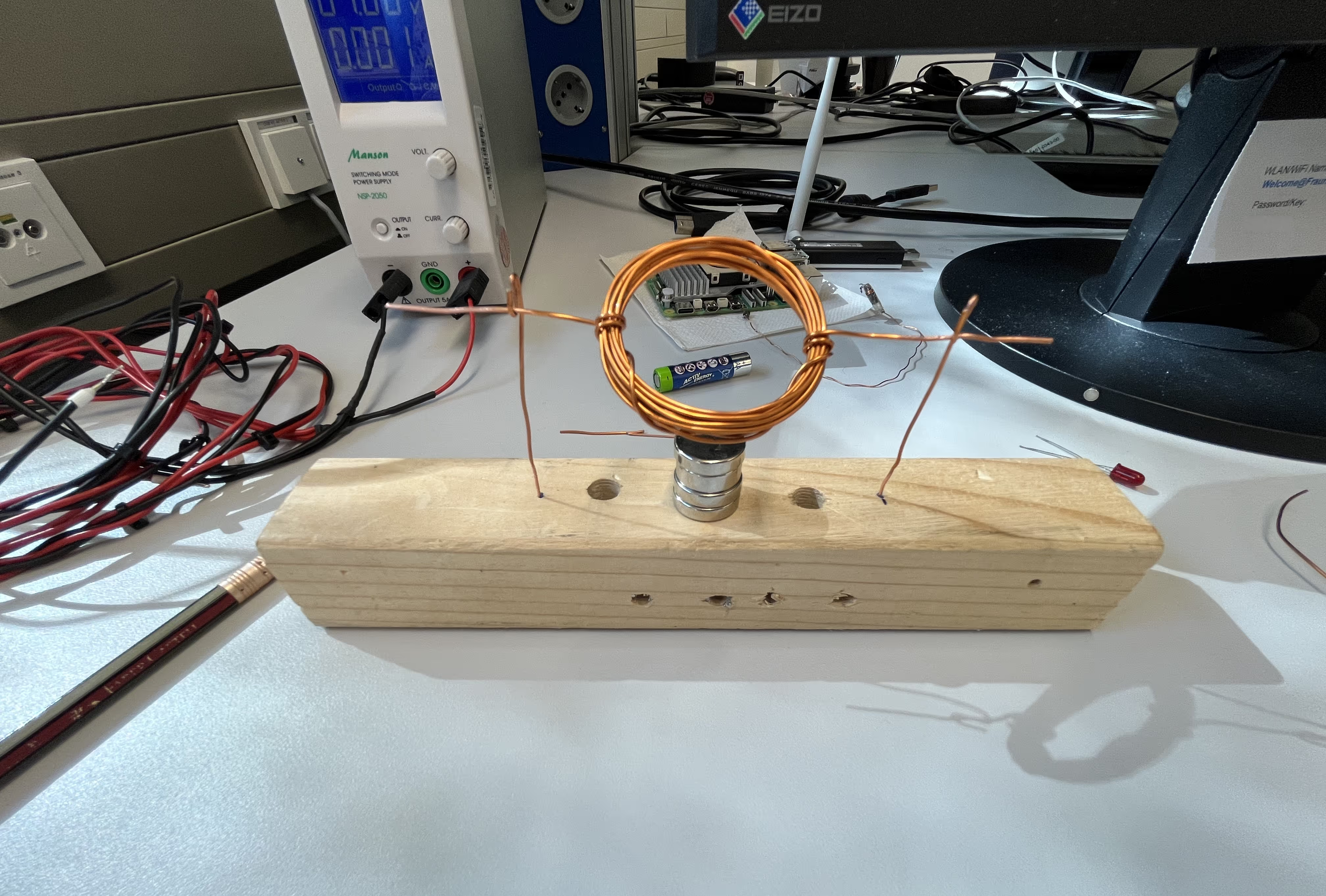
Initial Motor Experiments
Architecture
| Layer | Purpose |
|---|---|
| Electrical — Actuator | FOC driver PCB (KiCad) |
| Electrical — Mainboard | ESP32 main board |
| Mechanical — Actuator | Motor housing, gearbox CAD |
| Mechanical — Body | Frame, legs, feet |
| Firmware — STM32 | FOC controller per actuator |
| Firmware — ESP32 | Main control loop, comms, safety |
| Simulation — Model | MJCF + meshes |
| Simulation — Envs | Gymnasium environments |
| Training | RL training scripts + configs |
| Deployment | Policy → weights → MCU inference (C) |
Key Design Decisions
Custom actuators over off-the-shelf servos. Torque and velocity control matter for learning-based policies. FOC-driven BLDC motors give direct torque control, multiple operating modes, and hopefully silent operation.
Learning over scripting. Scripted gaits are brittle. An animal doesn't have a lookup table for every terrain — it has a nervous system that adapts. The robot should build a repertoire of skills through interaction, not through my engineering effort.
Open source. This is the kind of project where sharing the work multiplies its value. Documenting everything as I go.
Status
Early-stage. Mechanical design underway in Onshape, project structure established, research into actuator design ongoing.